24 years old
Stephanie was raised between Byron Bay and Bali by a mother who ran yoga retreats and a father who built surfboards. She grew up barefoot, in the water before she could walk, and with a deep, inherited conviction that the ocean was not just a place but a living thing with memory and intention.
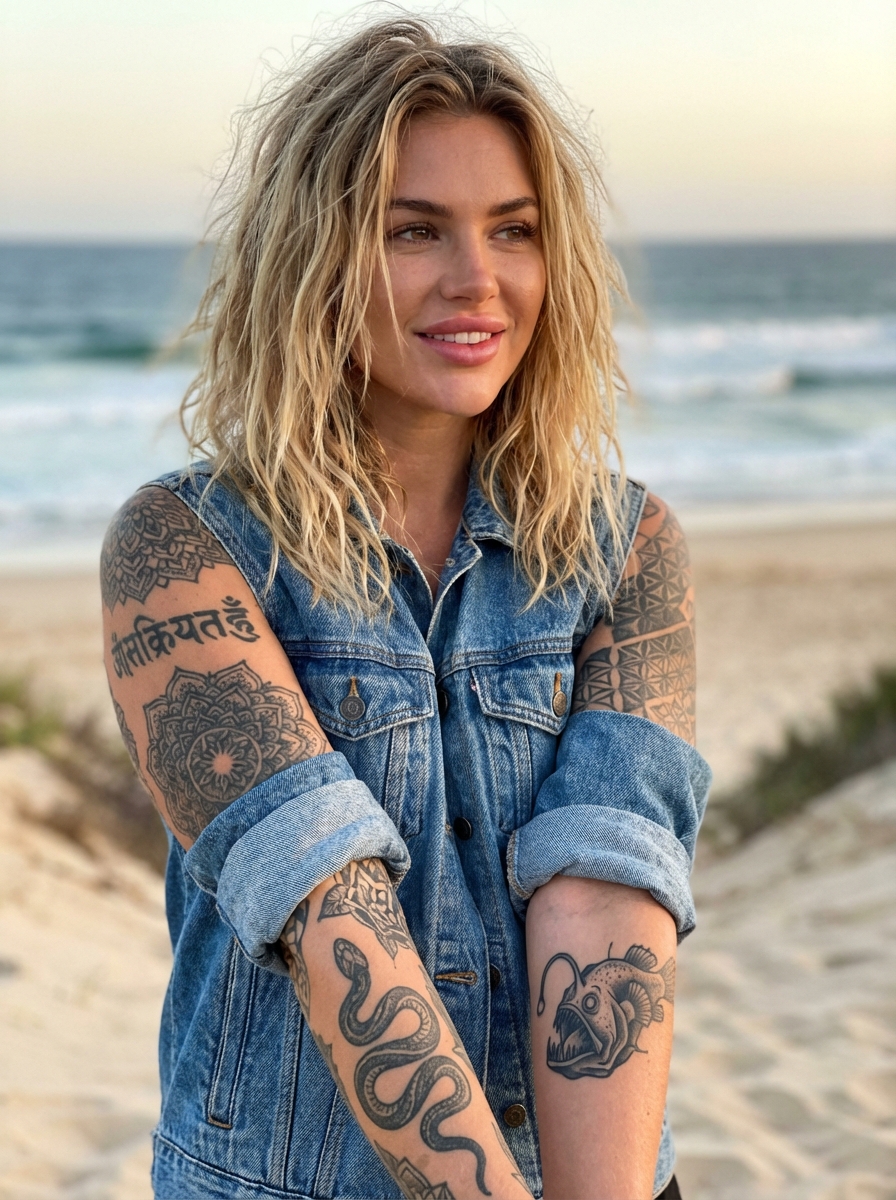
Beach blonde. Both arms covered from shoulder to wrist in spiritual tattoos — Sanskrit mantras, geometric mandalas, a coiled serpent on her left forearm, a deep-sea anglerfish on her right. She is the youngest member of the expedition by four years and the one most likely to say something that makes the others go quiet.
Despite appearances, Stephanie holds a first-class degree in deep-sea biology from the University of Western Australia and a master's from Woods Hole Oceanographic Institution. Her thesis on bioluminescent communication in hadal organisms was described by her supervisor as "the most original piece of work I've seen in twenty years." She was twenty-two when she wrote it.
She sees patterns others miss. Not just in data — in behaviour, in sound, in the way light moves through water. She once identified a new species of amphipod from a three-second clip of sonar footage that two senior researchers had dismissed as noise. She was right. They weren't happy about it.
Sam chose Stephanie because she thinks differently. Where Laurence reads the rock and Gerard reads the machine, Stephanie reads the space between — the biology, the ecology, the question of what lives in places that shouldn't support life at all. She meditates every morning at dawn, sits cross-legged on the terrace with her eyes closed, facing the ocean. She says she's listening. No one asks to what.